Trade/Order fields unavaliablity for today

Exchange is conducting an unannounced activity that would impact impact the avaliablitliy of these fields. We’ll be in touch with the exchange to restore the data for these fields today after market hours

In the meantime, please disable the filters of “Trade & Order book” fields so that this doesn’t impact your scans due to non avaliablity of data for today

Update 30th May’21 – We are still awaiting the data from NSE on this.

Trade and Order book data now avaliable

We’ve recently added fields from “Trade book” and “Order book” to help you gain deeper insights into how they impact the price. Below is the list of new fields added:

Trade book fields:

The below fields can be accessed across all timeframes, starting from 1 minute to a yearly timeframe

    • Buyer-initiated tradesIndicates the number of trades that were executed at sellers/offer/ask price; an increasing number would indicate buyers are more aggressive than sellers.
    • Buyer-initiated trades quantity – Indicates the number of trades that were executed at sellers/ask price; an increasing quantity would indicate more number of shares are being bought at a price as requested by sellers.
    • Buyer-initiated trades average quantity – Indicates the average quantity of trades for “buyer-initiated trades.”
    • Seller-initiated trades – Indicates the number of trades executed at a buyers/bid price; an increasing number would indicate sellers are more aggressive than buyers.
    • Seller-initiated trades quantity – Indicates the number of trades executed at a buyers/bid price; an increasing quantity would indicate more shares are being sold at a price as requested by buyers.
    • Seller-initiated trades average quantity– Indicates the average quantity of trades for “seller-initiated trades.”
    • Buyer vs. Seller initiated trades ratioA ratio of “buyer initiated trades / seller initiated trades” above 1 indicates that buyer-initiated trades are more than Seller for the given timeframe
    • Buyer vs. Seller initiated trades quantity ratioA ratio of “buyer initiated trades quantity / seller initiated trades quantity” above 1 indicates that the buyer-initiated quantity of trades is more than the Seller for the given timeframe.
    • Buyer-initiated trades VWAP – Volume weighted average price (VWAP) of trades that buyers initiated.
    • Seller-initiated trades VWAP Volume weighted average price (VWAP) of trades that sellers initiated.

These fields can be used to evaluate trades for intraday, short or long-term, as they are available across all timeframes. There has been limited research on these fields, as their availability is limited, considering the amount of data that needs to be processed for these. Here’s one interesting research paper on this.

Order book fields:

The below fields can be accessed across all timeframes, starting from 1 minute to a yearly timeframe

    • Orders Indicates the orders received for the specified timeframe, e.g., total orders within a minute
    • Orders Quantity – Indicates the number of orders received for the specified timeframe, e.g., total order quantity within a minute.
    • Buy Orders Indicates the “Buy orders” received for the specified timeframe.
    • Buy Orders Quantity Indicates the “Buy order” quantity received for the specified timeframe.
    • Sell Orders Indicates the “Sell orders” received for the specified timeframe.
    • Sell Orders Quantity  Indicates the “Sell order” quantity received for the specified timeframe.
    • Buy vs. Sell orders ratioA ratio of “Buy orders / Sell orders” above 1, indicating buy orders are more than sell orders.  
    • Buy vs. Sell quantity ratio A ratio of “Buy orders quantity / Sell orders quantity” above 1, indicating buy order quantities are more than sell order quantity.
    • Canceled Buy Orders – Indicates the total orders canceled in the specified timeframe.
    • Canceled Buy Orders Quantity Indicates total buy orders quantity canceled in the specified timeframe.
    • Canceled Sell Orders Indicates the total  sell orders canceled in the specified timeframe
    • Cancelled Sell Orders Quantity Indicates the total  sell orders  quantity canceled in the specified timeframe
    • Total Cancelled orders Indicates the total orders canceled in the specified timeframe
    • Total Cancelled orders quantity – Indicates the total order quantity canceled in the specified timeframe
    • Canceled orders ratioA ratio of “Cancelled orders / Orders” gives an idea of the pie of orders being canceled from the ones received
    • Canceled orders quantity ratio A ratio of “Cancelled orders quantity / Orders quantity” gives an idea of the pie of orders quantity being canceled from the ones received
    • Buy Orders Vwap – Volume weighted average price (VWAP) of buy orders.
    • Sell Orders Vwap – Volume weighted average price (VWAP) of sell orders.
    • Orders Vwap – Volume weighted average price (VWAP) of all orders.

The order numbers indicated above are the actual orders(not disclosed) for the cash market & hence the values will not match with the market depth seen within your broker’s terminals, which helps get a much clearer picture of how this is driving the price of a stock.

These new fields can be combined with existing functions, e.g., SMA, Min, Max, Count and so on.. to derive onto more complex indicators.

Sample dashboards

Buyer vs. Seller initiated trades

While we are working on adding more scans & dashboards for the same, I wanted you to be updated on adding these new fields. HI hope these are useful for gaining more insights along with the existing fields of technical analysis.

New scans for Shareholding & Net Profit growth

We’ve recently added the ability to scan over 400+ fields including fields from Balance seet, Cash flow, P&L & shareholding pattern. Below are a few scans, dashboards showing usage of these new fields:

Scans

DASHBOARDS

We shall continue updating these list based on scan requests from users to find stocks that are fundamentally strong

Network issues for Jio/Vodafone users

We are seeing issues  while reaching our site on jio/vodafone internet connection, we have reached out to these providers to help resolve this issue as it relates to a network server issue.

We have already raised a ticket with our network provider & they are seeing this issue with other sites as well, including sbicards.com, opera.com and so on.. this issue is something not within our control as it depends on other upstream network providers.

Their team is still investigating on the root cause for the same, may I suggest you to use:

  1. A different network connection, if possible.
  2. Use a proxy site or use opera as it comes with free VPN

We are in constant touch with our provider and shall let you konw as soon as we hear back from them, until then, please use the above methods to visit our site

Aug 18th’20: 12:30pm -> The issue is now solved across all providers, we have also taken necessary steps to avoid this in future, including migrating to a different network provider, if necessary.

Alerts for scans on Telegram/Slack using ifttt.com

Webhooks can now be used to send our alerts over Telegram/slack channels; the below 2 videos guide you through the process for Telegram. The process for Slack, too, would remain the same.

  • Video 1 takes you through creating a service on https://ifttt.com that listens to webhook hook events and then sends a message to telegram. Note, you’ll need to connect your telegram channel and follow the steps mentioned over the telegram channel while you are setting this up(you can do so on the mobile since you already might have the telegram app installed, and it might be faster to perform this step on the mobile)
  • Video 2 takes you through the process of testing the webhook & note if the telegram is being triggered. At the end of the 1st video, you’ll notice I clicked on the “Documentation” in the top right corner; that’s the page that would provide us the detail for the webhook URL to test against & is used in the 2nd video.

This should be a good starting point for using ifttt.com for other services as well(including Slack and Telegram); please let us know if you get stuck anywhere.

NOTE: Starting February 2024, listening to webhooks via ifttt.com is no more a free service. Alternate options are being explored.

Webhook support for Alerts

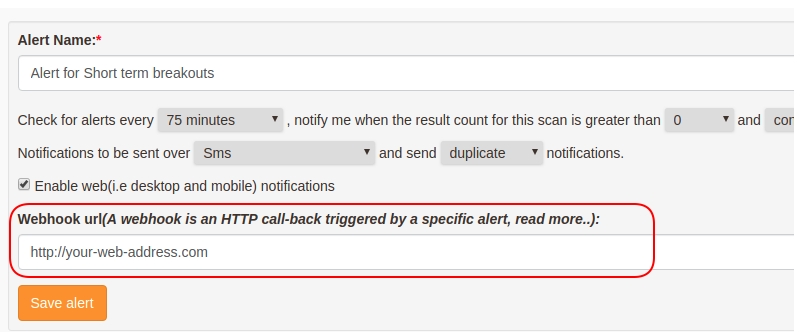
We’ve added the ability to add webhook’s for your alerts. A webhook is an HTTP call-back triggered by a specific event(in our case a alert), these can be used by your own application to monitor, place automatic orders.. etc. You can add webhooks for any given alerts by entering the URL for your web address(prefixed by http, https), this can be done by clicking on “Create/Modify Alert” right below your scans:
SAMPLE Post Data(json)
{
    "stocks": "SEPOWER,ASTEC,EDUCOMP,KSERASERA,IOLCP,GUJAPOLLO,EMCO",
    "trigger_prices": "3.75,541.8,2.1,0.2,329.6,166.8,1.25",
    "triggered_at": "2:34 pm",
    "scan_name": "Short term breakouts",
    "scan_url": "short-term-breakouts",
    "alert_name": "Alert for Short term breakouts",
    "webhook_url": "http://your-web-hook-url.com"
}

Webhooks will triggered along side your alert settings, eg: sending alerts over Email/SmS/Desktop would continue as normal

Note on automating trades with webhooks, requires some programming logic so that you can incoporate our webhooks within your application which is alreadying using API’s from the stockbrokers to place orders. Your system/application must be deployed on the internet and reachable by a domain or a IP address, this requires your application to support the ability to receive incoming POST request‘s so that we can send our JSON data for the alert

We recommend using a service like Hookbin to test the webhooks feature, it allows you to create a endpoint, which you can add in our “webhook url” field within the alert form. An HTTP POST request will be made to the URL you have specified along with the data corresponding to the alert.

Change colors for table columns, line, bar and Pie charts

We’ve released support to change/customize colors for widgets, including table colors for table columns, line, bar and pie charts. Below is a demo showing the process to change colors:

Customizing colors as per your needs would help you easliy identify the levels/columns that interest you first. Color changes can be made to Tables as well any types of Chart(pie/line/bar/area).


Now create your own Custom Indicators !

We’ve recently added the ability to create your own custom/derived indicators using existing indicators.

For example, you may have your logic of HLC3 as is “high  + low + close / 3” & would want to use this across multiple filters in different/same scans/widgets. Until now, you’d need to copy/write the logic whereever it would required.

With “custom indicators”, you can simply define its logic as:

HLC = ( current candle high + current candle low + current candle close ) / 3

Here’s the custom indicator for the above logic: https://chartink.com/indicator/hlc3

The above created indicator can then be used to create new scans/widgets: https://chartink.com/screener/close-above-hlc3 (notice the HLC indicator selection)

These are similar to having a value saved in a variable/temp working space and then using it across in multiple scans. Note, while using it across scans, you can select the timeframe for its calcuation, eg: Daily/Weekly/Monthly or Intraday candles giving you further flexibility.

To access a previous candle for a given timeframe, you can select “1/2.. candles ago”.

Below is another example from one of our users:

EOM – CUSTOM INDICATOR LOGIC
Scan using SMA on EOM(custom indicator)https://chartink.com/screener/eom-greater-than-20


Scanner updates

We have recently released major scanner updates, the post summarizes their usage & benefits:

  1. Drag and Drop filters across groups or re-arrange them across the scan
  2. Duplicate group or a single filter
  3. Copy the filter to clipboard
  4. Count & Countstreak functions
  5. Least & Greatest functions
    1. Drag and Drop filters across groups or re-arrange them across the scan -> Allows to you drag and drop across different groups to make re-oraganinzing a scanner, press left mouse button and drag/move your while the button is pressed to move the filters, sample video below,
    2. Duplicate group or a single filter -> Duplicate a filter or a group by clicking on the copy icon as seen below
    3. Copy the filter to clipboard -> Copy filter text to clipboard by clicking on the “word” icon, as seen below
    4. Count & Countstreak functions -> Helps you to count the total number of times a given filter in the past candles
      Count eg: ->Filter “Latest count( 50, 1 where latest close > latest upper bollinger band ( 20 , 2 ) ) greater than equal to 2” will return all stocks that have closed above the upper bollinger band for 2 or more days in the past 50 days

      Countstreak eg: -> Filter “Latest countstreak( 20, 1 where latest close > latest sma ( latest close , 200 ) )greater than equal to 10” will return all stocks that have continesouly(in a streak) closed above its 200 SMA for the past 10 or more candles(daily timeframe)

    5. Least & Greatest functions -> Helps to get the greatest or the least of a given set of filters
      eg: greatest( Latest Open, Latest Close ) will return the greatest value from either the open or the close

We hope these additional features will further simply your scanner creation. If you do have any queries please feel free to leave a comment here or reach us at [email protected]