Web notification troubleshooting

This page focuses on troubleshooting the issues related to push notifications on your desktop and Android mobile devices.

FOR DESKTOP NOTIFICATIONS

If you are unable to see the demo notification pop-up after visiting the demo-notification link, follow the below steps for troubleshooting the same:

STEP 1: Ensure Notifications are allowed on the Chrome browser:

Ensure notifications are allowed in the settings for your browser by clicking on the “lock” sign next to the URL as shown below and going to “site settings” and ensuring “notifications” and “pop-ups and redirects” are set to “Allow”.
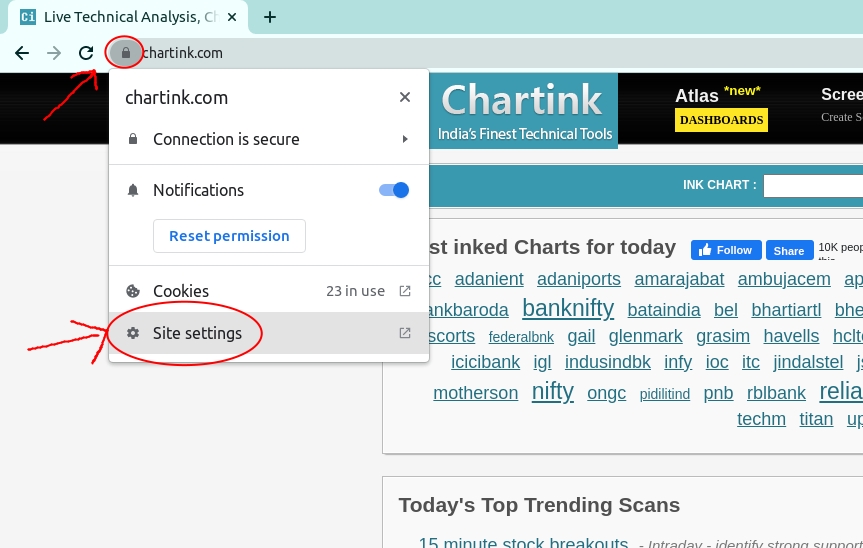
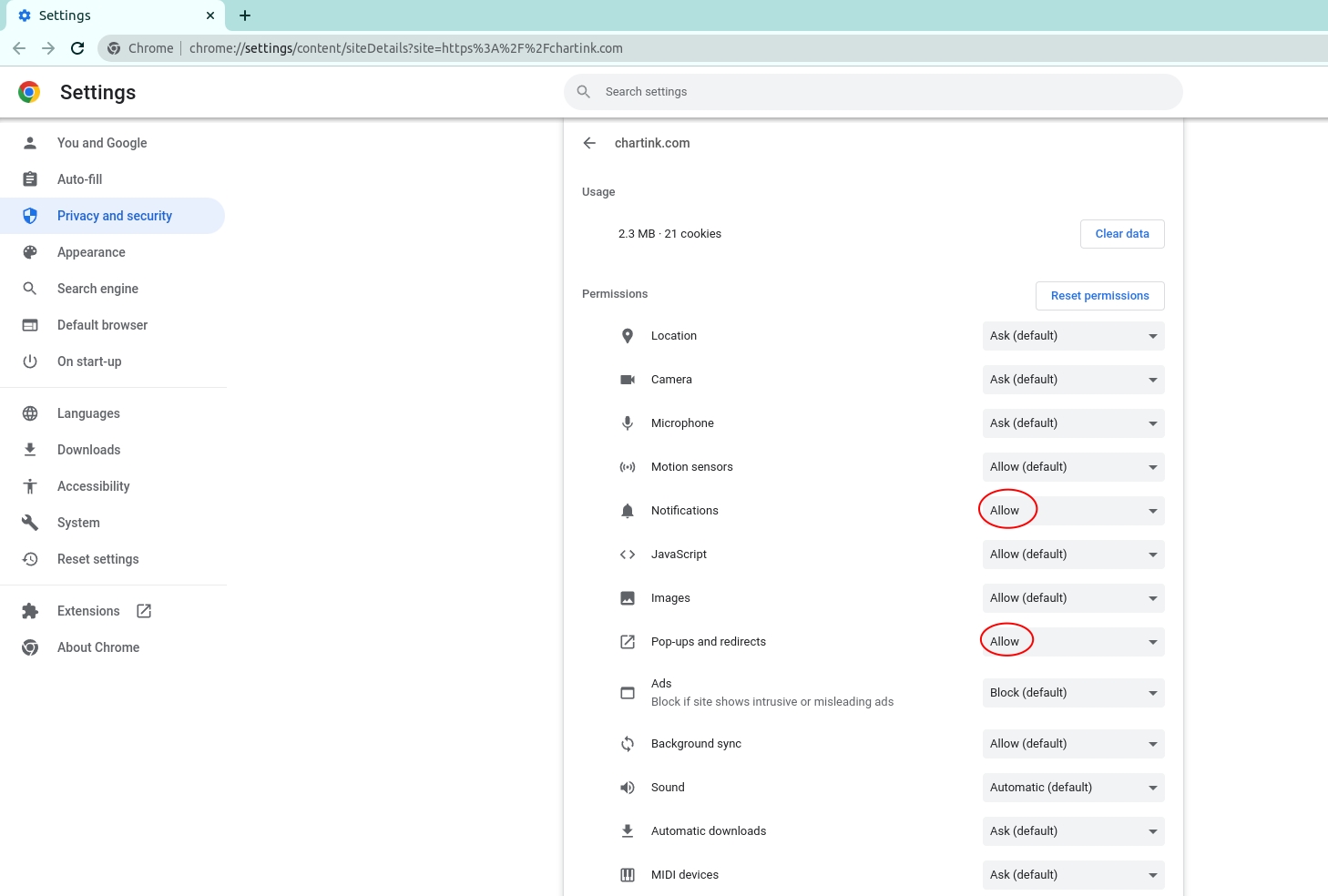


Once this is done, try running the demo notification link again. If you now get a pop-up, you’ve successfully enabled web notifications on your desktop.

Step 2: Ensure Notifications for Chrome are enabled on Windows:
  • Open the system settings
  • Click on Notifications & actions
  • Under “Get notifications from these senders,” select Google Chrome and ensure notifications are enabled.
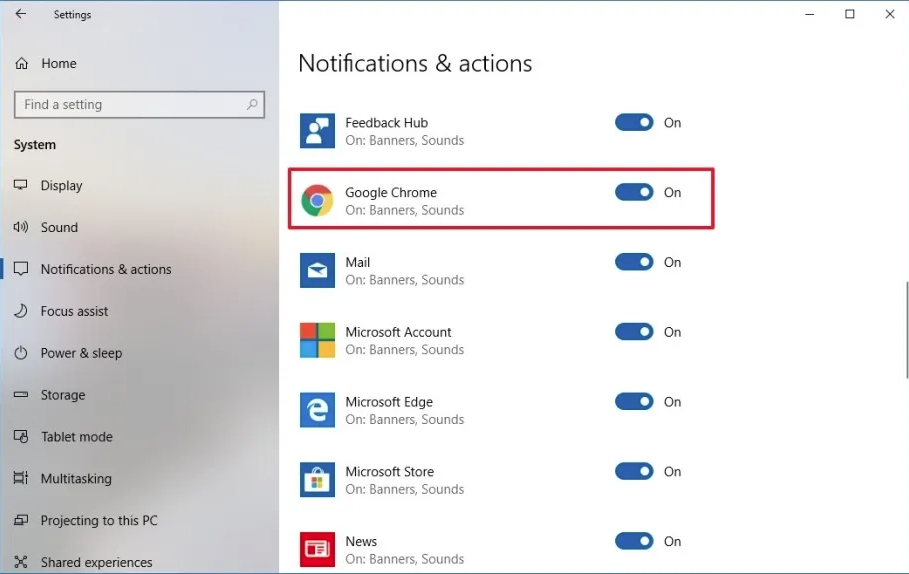
Once enabled, you can run the demo notification again; you should now get a pop-up on your desktop. If you still do not receive a pop-up, kindly contact our support team here for further support – [email protected].

FOR MOBILE (Android) NOTIFICATIONS:

If you are unable to see the demo notification pop-up after visiting the demo-notification link, follow the below steps for troubleshooting the same:

Step 1: Ensure Notifications are allowed on the Chrome browser:

Follow the below video tutorial to enable web push notifications on mobile. Please note web push notifications on mobile are supported only by Andriod devices.

Once this is done, try running the demo notification link again. If you now get a pop-up, you’ve successfully enabled web notifications on your android device.

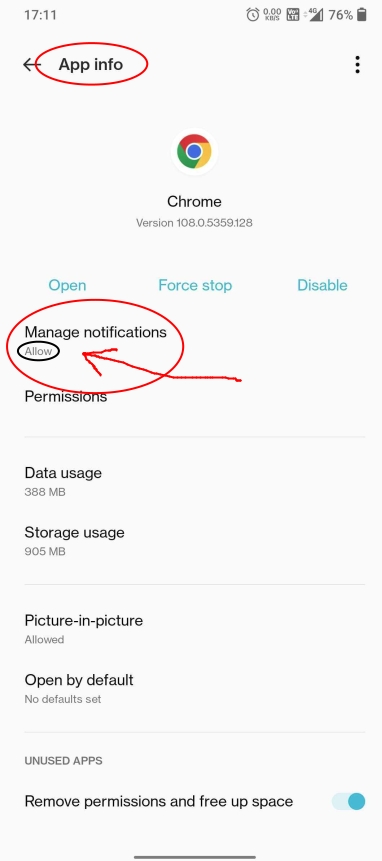
Step 2: Ensure Notifications for Chrome are allowed via the phone’s app settings:
  • Open your phone’s Settings app
  • Tap Notifications
  • Go to  App settings/App management
  • Locate the app “Google Chrome.”
  • Tap the app
  • Ensure notifications for this app are “Allowed.”
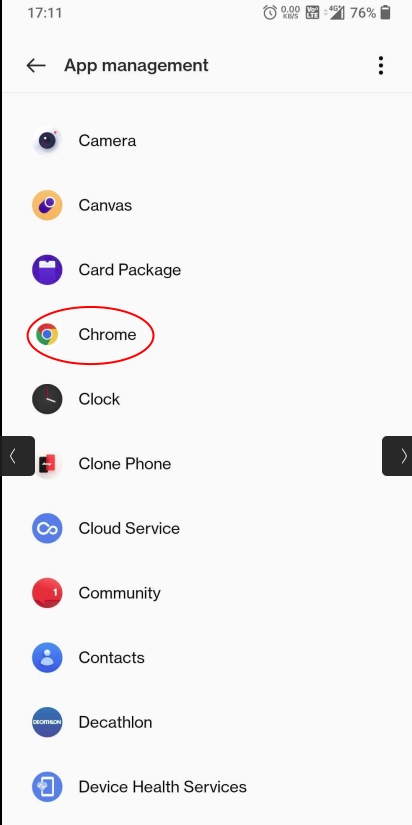
 

Once this is done, try running the demo notification link again. You should now get a pop-up on your mobile device.

If you still need any help, kindly contact us at [email protected]
Alerts for scans on Telegram/Slack using ifttt.com

Webhooks can now be used to send our alerts over Telegram/slack channels; the below 2 videos guide you through the process for Telegram. The process for Slack, too, would remain the same.

  • Video 1 takes you through creating a service on https://ifttt.com that listens to webhook hook events and then sends a message to telegram. Note, you’ll need to connect your telegram channel and follow the steps mentioned over the telegram channel while you are setting this up(you can do so on the mobile since you already might have the telegram app installed, and it might be faster to perform this step on the mobile)
  • Video 2 takes you through the process of testing the webhook & note if the telegram is being triggered. At the end of the 1st video, you’ll notice I clicked on the “Documentation” in the top right corner; that’s the page that would provide us the detail for the webhook URL to test against & is used in the 2nd video.

This should be a good starting point for using ifttt.com for other services as well(including Slack and Telegram); please let us know if you get stuck anywhere.

NOTE: Starting February 2024, listening to webhooks via ifttt.com is no more a free service. Alternate options are being explored.

Webhook support for Alerts

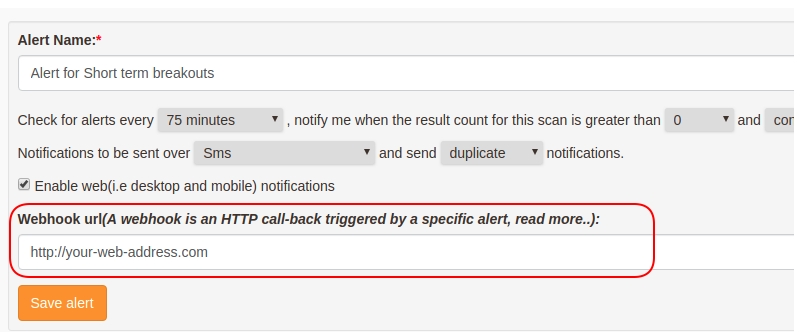
We’ve added the ability to add webhook’s for your alerts. A webhook is an HTTP call-back triggered by a specific event(in our case a alert), these can be used by your own application to monitor, place automatic orders.. etc. You can add webhooks for any given alerts by entering the URL for your web address(prefixed by http, https), this can be done by clicking on “Create/Modify Alert” right below your scans:

SAMPLE Post Data(json)
{
    "stocks": "SEPOWER,ASTEC,EDUCOMP,KSERASERA,IOLCP,GUJAPOLLO,EMCO",
    "trigger_prices": "3.75,541.8,2.1,0.2,329.6,166.8,1.25",
    "triggered_at": "2:34 pm",
    "scan_name": "Short term breakouts",
    "scan_url": "short-term-breakouts",
    "alert_name": "Alert for Short term breakouts",
    "webhook_url": "http://your-web-hook-url.com"
}

Webhooks will triggered along side your alert settings, eg: sending alerts over Email/SmS/Desktop would continue as normal

Note on automating trades with webhooks, requires some programming logic so that you can incoporate our webhooks within your application which is alreadying using API’s from the stockbrokers to place orders. Your system/application must be deployed on the internet and reachable by a domain or a IP address, this requires your application to support the ability to receive incoming POST request‘s so that we can send our JSON data for the alert

We recommend using a service like Hookbin to test the webhooks feature, it allows you to create a endpoint, which you can add in our “webhook url” field within the alert form. An HTTP POST request will be made to the URL you have specified along with the data corresponding to the alert.

Desktop/Mobile (a.k.a Web) notifications

We are happy to launch Desktop & mobile notifications for Alerts; they allow you to receive alert notifications across multiple devices (mobile/desktop) that have a modern browser installed (for example, Google Chrome/Firefox).

Please follow the below simple steps to enable these notifications:

FOR DESKTOP NOTIFICATIONS

STEP 1: Visit our site, chartink.com on your desktop/laptop.

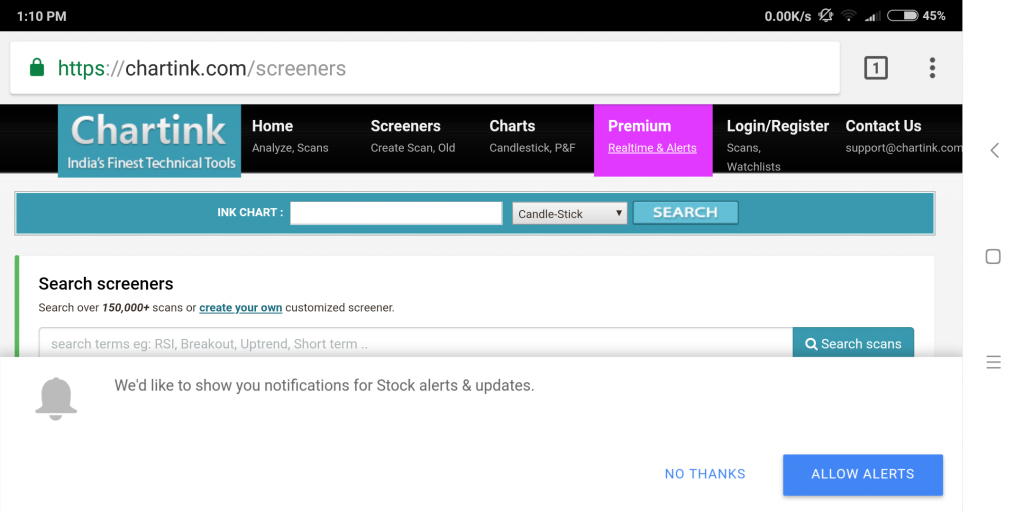
STEP 2. a: You will be prompted with a message as below; click “Allow Alerts” to proceed. If the prompt is not visible, perform the next step (step 3).

Alert notification prompt

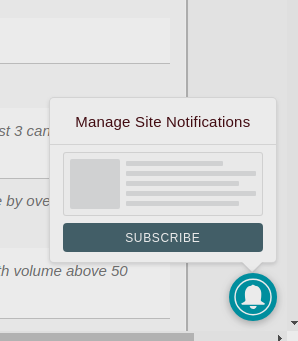
STEP 2. b: Skip this step if you are able to see the above prompt. If not, search for the “Bell” icon at the bottom right of our site & click on it to “Subscribe” for notifications

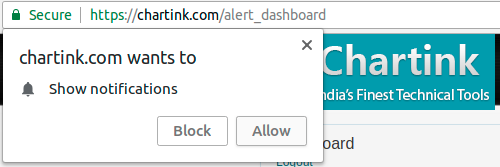
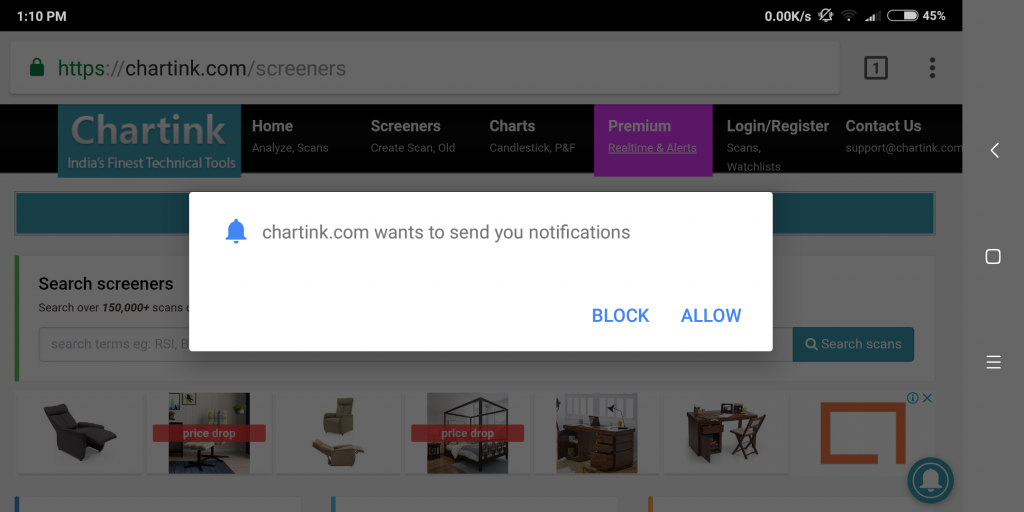
STEP 3: Click “Allow” to enable notifications for our site:

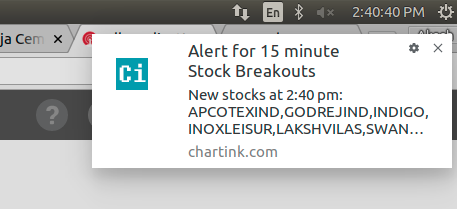
STEP 4: Finally, visit the  demo-notification page; you should receive a desktop notification; these notifications are enabled for all your activated alerts

Sample notification

Sit back and relax, we’ll show a pop-up(alert) on your computer screen once we notice new stocks are available in your screener.

If you face any issues, kindly review our troubleshooting guide or directly reach out to us at [email protected]

FOR MOBILE NOTIFICATIONS

Follow the below video tutorial to enable web push notifications on mobile. Note web push notifications on mobile are supported only by Andriod devices


STEP 1:  Visit our site, chartink.com, on your mobile device.

STEP 2. a: You will be prompted with a message as below; click “Allow Alerts” to proceed.

STEP 2. b(optional): Skip this step if you are able to see the above prompt. If not, search for the “Bell” icon at the bottom right of our site & click on it to “Subscribe” for notifications.

STEP 3: Click “Allow” to enable notifications for our site

STEP 4: Finally, visit the demo-notification page; you should receive a mobile notification. These notifications are enabled for all your activated alerts

If you face any issues, kindly review our troubleshooting guide or directly reach out to us at [email protected]

Alerts Guide

Alerts is a premium feature on chartink.com that allows users to receive notifications when stocks matching their specified criteria are identified by our screeners. These notifications can be delivered via Desktop/mobile web, SMS, or email and are continuously monitored to ensure that users are promptly notified of any new matches. In this guide, we will walk you through the process of setting up and managing alerts on our platform.

CREATING & MANAGING ALERT

For any screener you want to create an alert for, click the “Create Alert” button (right beside save as). If you’re still looking for good screeners, we suggest you start with our top-loved scans, which contain a good mix of intraday/swing and short-term scans.

Alert settings :

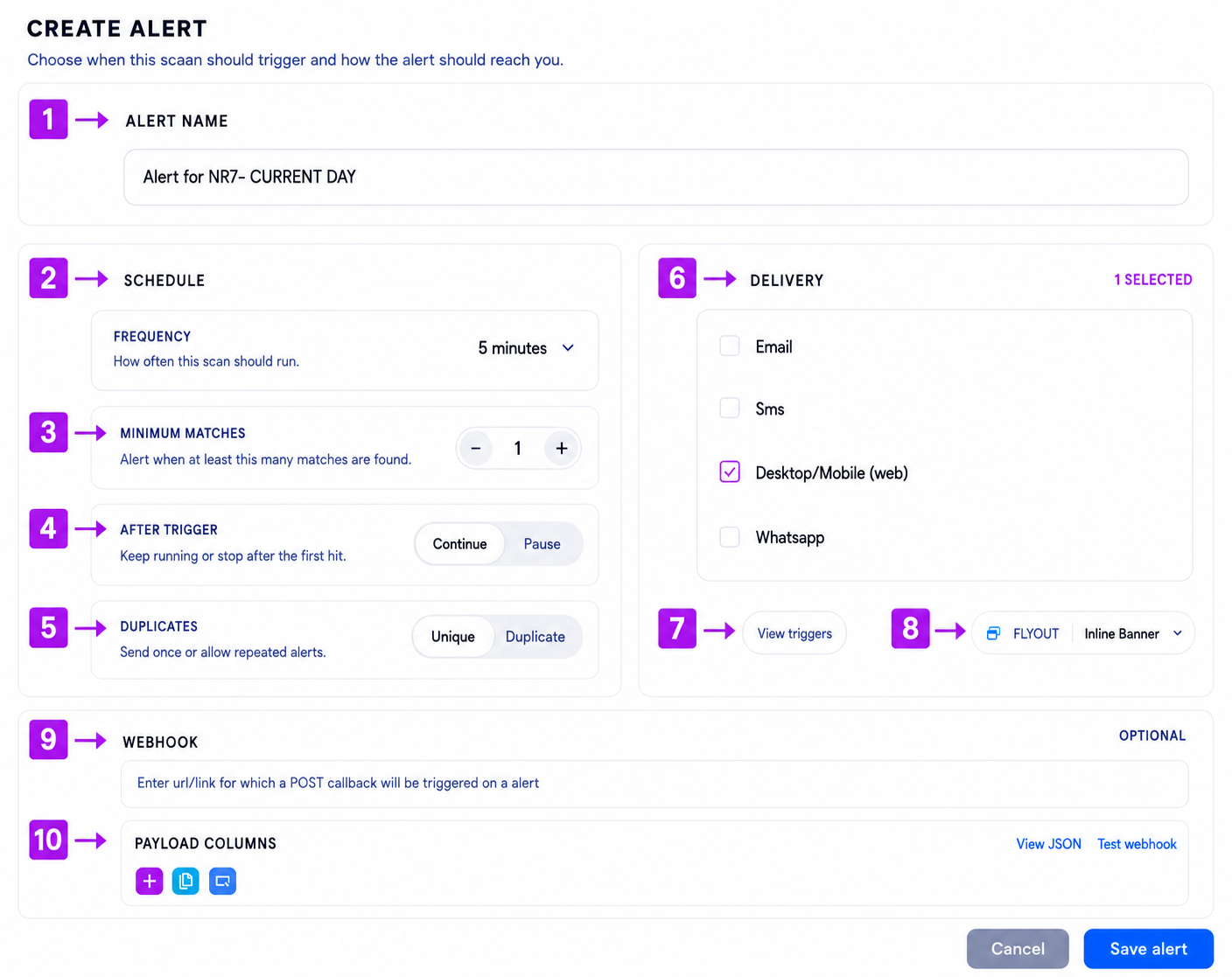
Please find below a thorough explanation of the alert box functionality:

Alert setting box

1) Alert Name –

Here, you can enter a custom name for your alert. This helps you easily identify and manage different alerts later. You may also use the same name as your scan if preferred.

2) Schedule / Frequency

The frequency option allows you to decide how often the alert scan should run.
You can configure alerts to trigger at intervals such as every:

  • 1 / 2 / 3 / 5 / 10 / 15 / 20 / 30 / 60 / 120 / 240 minutes
  • Market Open
  • Market Close

For more information on the frequency of alert execution, please refer to our FAQ.

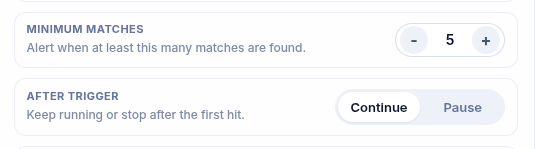
3) Minimum stocks to alerts

This option allows you to set the minimum number of stocks/results that must match the scan conditions before an alert is triggered.

For example:

  • If the Minimum Matches value is set to 5, the alert will only trigger when at least 5 stocks satisfy the scan conditions.
  • If only 2 or 3 stocks match, no alert will be sent.

4) After Trigger – 

This setting determines what should happen after the alert condition is triggered.

  • Continue – The alert will continue monitoring and triggering whenever conditions are met again.
  • Pause – The alert will stop automatically after the first successful trigger.

5) Duplicates (Unique / Duplicate Notifications)

Unique

With the Unique option enabled, you will receive only one alert per stock for the day, even if the stock matches the scan conditions multiple times.

Example: If a stock triggers the alert at 9:30 AM and again at 1:00 PM, you will receive only the first notification.

Duplicate

The Duplicate option allows repeated notifications for the same stock whenever it matches the scan conditions again during the day.

6) Delivery / Notification Methods

This section allows you to choose how you want to receive alert notifications.

Available notification methods include:

  • Email
  • SMS
  • Desktop/Mobile (Web) Notifications
  • WhatsApp Notifications

You can select one or multiple delivery methods as per your preference.

7) View Triggers

The “View Triggers” option allows you to see which stocks or scan conditions have already triggered the alert.

8) Alert Display Type (Flyout / Inline Banner)

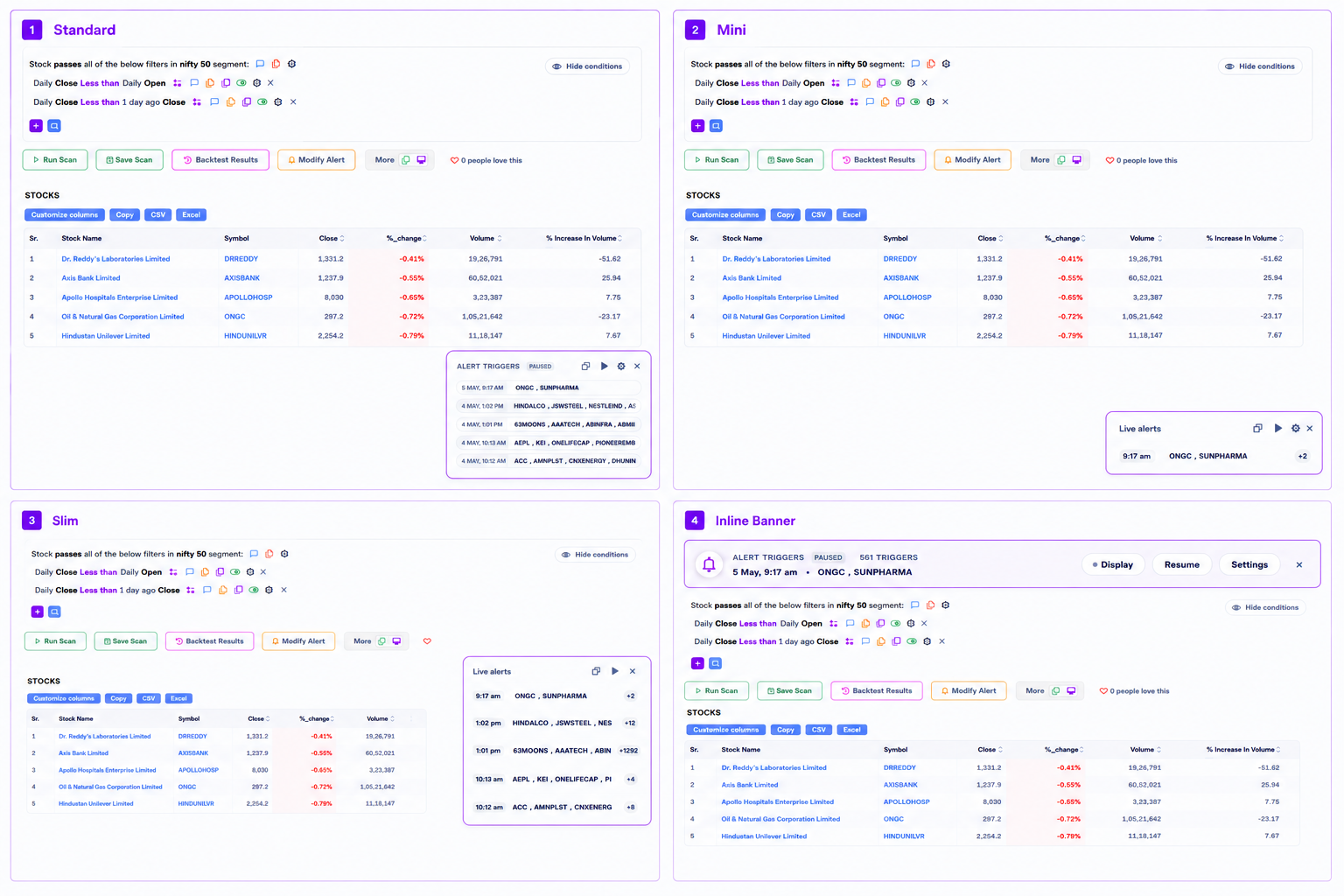
This option allows you to choose how alert notifications should appear on the screen.

  • Flyout – Displays alerts as popup-style notifications.
  • Inline Banner – Displays alerts within the platform interface as a banner.

9) Webhooks

The webhook feature allows alerts to automatically send data or messages to external applications whenever an alert is triggered.

When activated, the system sends an HTTP POST request to the provided webhook URL.
This enables automated communication between platforms and can be used for:

  • Algo trading
  • Third-party integrations
  • Automation tools
  • Custom workflows

10) Payload Columns

Payload Columns allow you to customize which stock data fields should be included in the webhook response or alert payload.

For example, you can include:

  • Stock Name
  • LTP
  • Volume
  • Indicator Values

Viewing alerts –

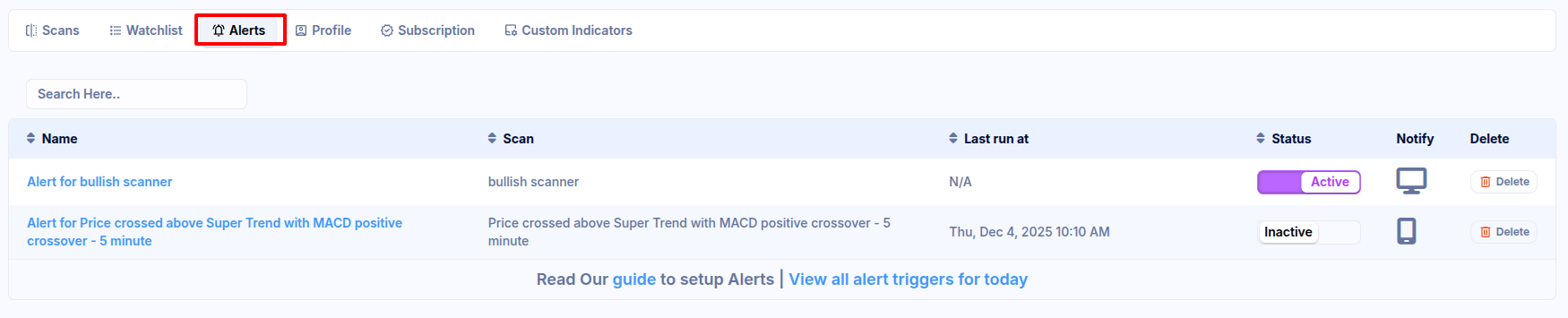
All alerts created can be viewed on the Alerts Dashboard.

Alert Triggers/HISTORY –

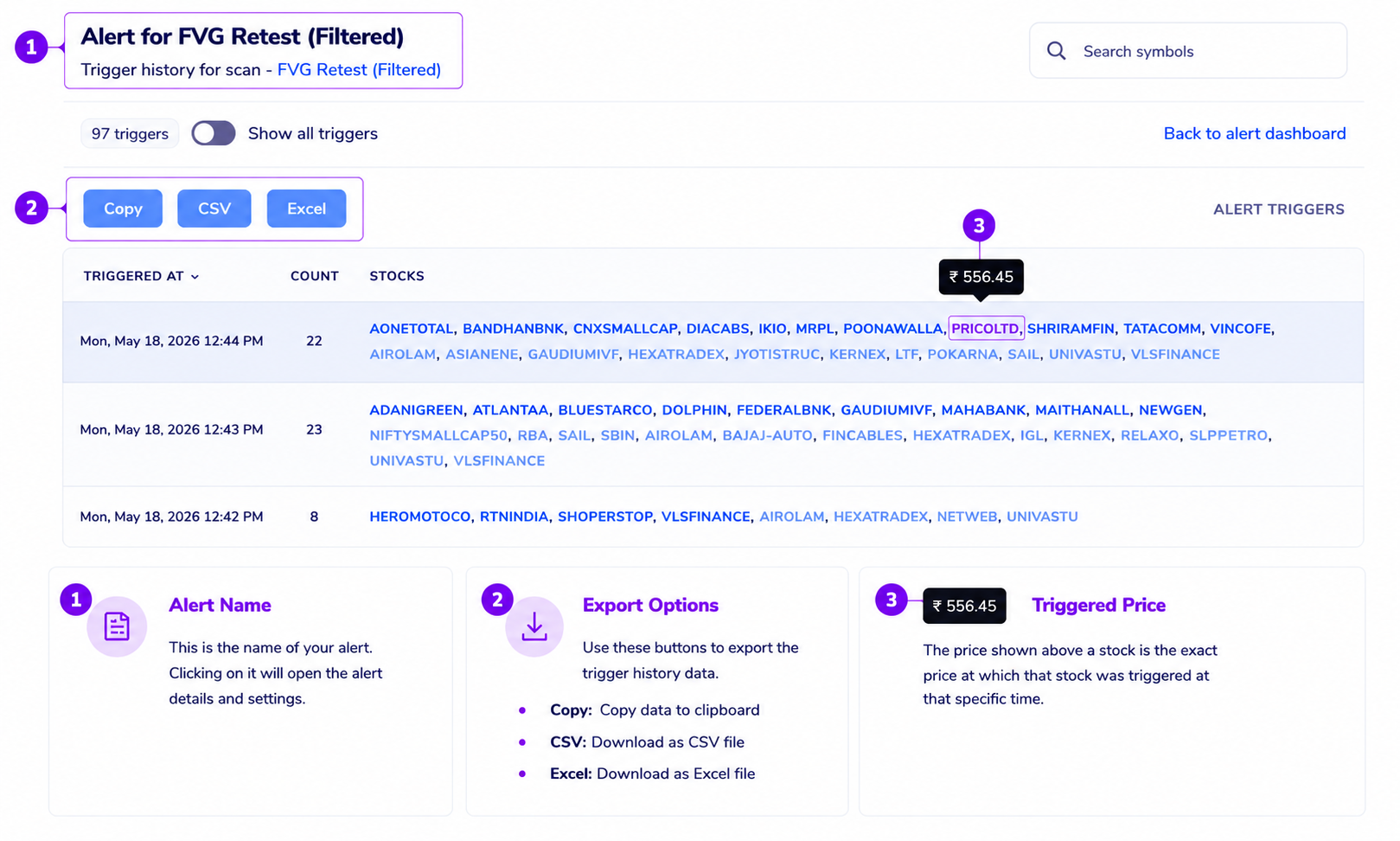
A trigger lets you know when alerts for screeners have been triggered, and new stocks have been filtered. You will receive alerts via email or SMS when notifications have been sent. You can access the alert triggers page by clicking any alerts on the Alerts Dashboard.

Frequently asked questions

Kindly refer to our FAQs for alerts here.

Feel free to reach us at [email protected] for any doubts.

Alerts FAQ

How to create alerts?

We’ve created a step-by-step guide on how to create alerts across any screener.

How many stocks are scanned for alerts?

We default to running scans for all NSE stocks unless you change a scan to run for a watchlist, nifty 50, nifty 100. The number of stocks scanned for is dependent on the scan definition.

When are intraday, daily, weekly and monthly alerts run?

    • Intraday – An alert for 1 minute starts running at 9:16am(Lowest time interval). Considering the latest data as of 9:15:59am, the next run would be at 9:17am.
    • Market open – Runs at 9:20am considering the latest data as of 9:19:59am.
    • Market close – Runs between 6pm-7pm daily
    • Weekly – Runs every Friday between 6pm-7pm
    • Monthly – Runs on the last day of the month between 6pm-7pm

Are the alerts live[in real-time]?

Yes, our scans run on the latest live data available eg. If you have configured to run a scan every 5 minutes, the first scan would be at 9:20am, which will be based on the data as of 9:19:59am. As we process dozens of scans for every user throughout the day, there could be a delay of up to 1 minute while you are notified.

How frequently would I be notified of alerts?

We send our alert notifications based on alert configuration. If you’ve set an alert to run every 5 minutes, it shall run at 9:20am, 09:25am, and 09:30am. We send you notifications ONLY when we find new stocks the scans to avoid spamming your SMS/mailbox.

How many alerts I shall receive?

We provide a total of 2,000 SMS & email credits in a month, which are used while sending alerts. These allow you to receive more than 90+ alerts per day. Notification credits(SMS & email) will be used at an alert level and independent of the number of stocks filtered in a scan. If an alert notifies you about 50 stocks, it will use a single notification credit.

What happens when your NOTIFICATION credits finish?

You can purchase additional SMS or Email credits. Visit your subscription dashboard to do so.

HOW DO WE SEE ALL THE ALERTS CONFIGURED?

We provide a alerts dashboard that allows you to configure and manage your active alerts.

Do you provide the scanners, or does the subscriber have to use his own scanners?

You can add alerts on any of the 1,50,000+ screeners‘ available on the site or create your own.

IS THERE FREE TRIAL AVAILABLE?

We provide all our other tools(scans, charts) free to use on our site. Alerts are resource intensive and is also supported by external services, including sms/email, which include additional costs’. Hence, we don’t provide a trial for the same.